Why Stormwater Becomes a Problem in the First Place
When rain falls on open land, it either soaks in or runs off. How much each depends on soil permeability, ground slope, and how much vegetation is present to slow water down. On properties with heavy clay soils — common across Susquehanna County and much of northeastern Pennsylvania — water doesn’t soak in quickly. It sits, it runs, and it finds the lowest point it can reach.
That lowest point is often a foundation.
Did You Know: Pennsylvania averages about 42 inches of rainfall per year, with the heaviest events concentrated in spring and early summer. Clay soils, which cover much of the region, have a percolation rate as low as 0.1 inches per hour — meaning water runs off fast and soaks in slowly.
Impervious surfaces make this worse. Driveways, rooftops, and compacted gravel deflect rain that would otherwise absorb into the ground. On a typical residential lot, a 2,000-square-foot roof can shed roughly 1,200 gallons of water during a single 1-inch rainstorm. That water has to go somewhere.
Stormwater management creates a path for that water — away from your home, away from low spots, and toward a controlled outlet.
The Role of Grading: The First Line of Defense
Before any pipe or drain gets installed, the shape of the land matters more than anything else. Grading — reshaping the soil to create the right slope — is how water gets redirected at the surface level before it ever reaches a structure.
What Proper Grading Looks Like
The standard recommendation for residential grading is a slope of at least 6 inches of drop for every 10 feet of distance away from a foundation. That slope moves surface water away from the building before it can pool against the sill or seep into a basement.
On a flat lot, this is relatively straightforward. On a property with a complex grade or one that sits downhill from neighboring land, grading becomes more involved — and sometimes requires bringing in fill to raise certain areas, cutting others down, or reshaping the entire drainage flow path across the property.
When Grading Alone Isn’t Enough
Grading solves surface water problems. It doesn’t address groundwater. If water is migrating through the soil toward your foundation — rather than running across the surface — you’ll need subsurface drainage in addition to any grading work. A property that’s been graded but still shows basement moisture is almost always dealing with both problems at once.
Pro Tip: Walk your property within 30 minutes of a heavy rain. Note where water stands, where it flows, and which direction it moves. That observation tells you more about your drainage situation than any visual inspection on a dry day.
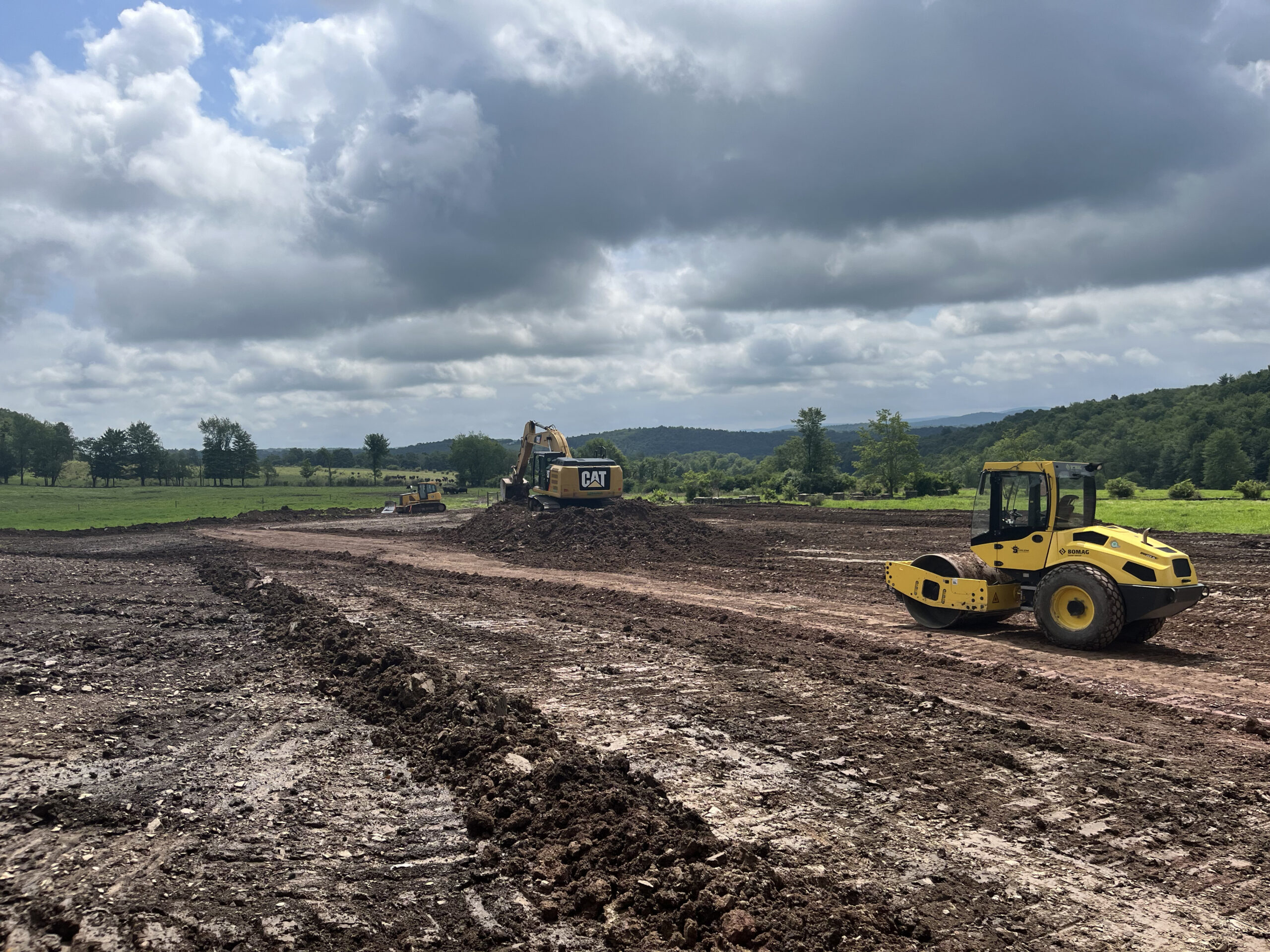
Our excavation and site work services include regrading as part of broader site work — and getting the grade right during an excavation project is always easier and less expensive than correcting it afterward.
French Drains: Subsurface Drainage Where Grading Falls Short
A French drain is a perforated pipe buried in a gravel-filled trench. It collects groundwater and surface water that’s infiltrated into the soil and redirects it to a lower point — a daylight outlet in a slope, a catch basin, a dry well, or a swale.
How They Work
Water enters the pipe through perforations, travels along the pipe’s slope, and exits at a discharge point away from the problem area. The surrounding gravel acts as a filter and collection zone, pulling water from the surrounding soil and feeding it into the pipe continuously.
French drains are particularly effective around foundations, in areas with high water tables, alongside retaining walls, and in yards that stay wet long after rain has stopped.
What They Don’t Do
A French drain is not a solution for a property that receives large volumes of surface runoff from uphill. If your neighbor’s lot drains toward yours, a French drain near your foundation will help — but it won’t stop water from pooling in the yard. That situation typically needs a combination of grading, surface swales, and possibly a catch basin.
Did You Know: The “French drain” was popularized in the U.S. by Henry Flagg French, a New Hampshire lawyer, judge, and farmer who described the technique in his 1859 book Farm Drainage. The modern version uses perforated PVC or corrugated pipe instead of the clay tiles French used, but the principle hasn’t changed in 165 years.
Swales: Surface Channels That Move Water Across a Property
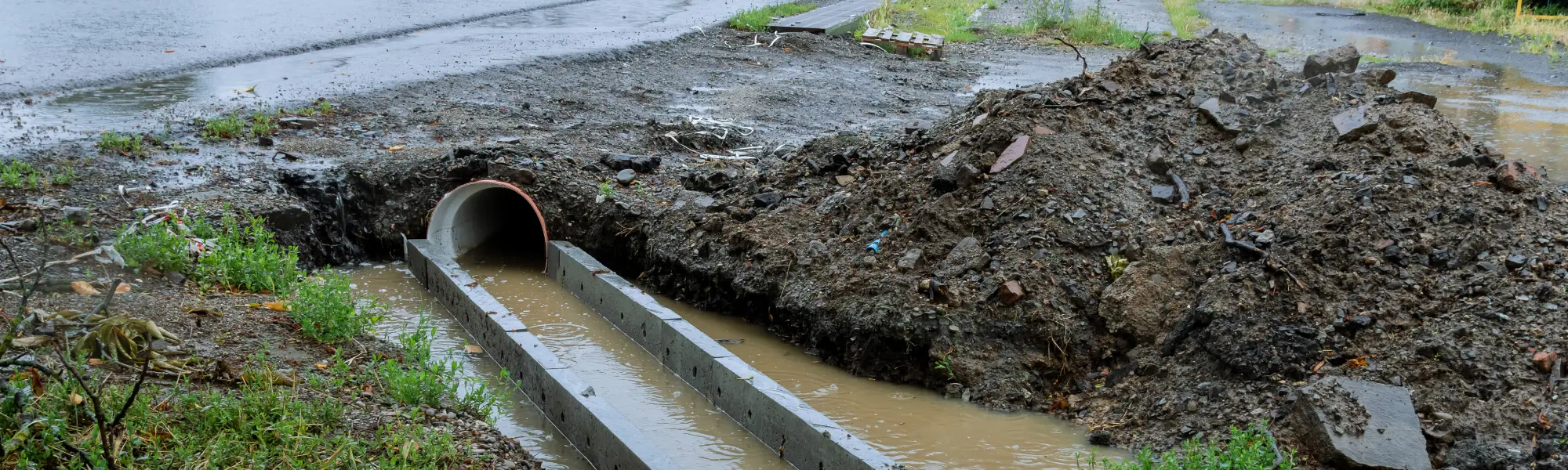
A swale is a shallow, gently sloped channel — either grass-lined or lined with riprap — that carries surface water across a property and directs it toward a safe discharge point. Unlike a French drain, a swale works at the surface level, handling water before it infiltrates the soil.
When Swales Make Sense
Swales work best on larger lots, rural properties, and anywhere surface runoff needs to travel a significant distance before reaching an outlet. A properly designed swale can move large volumes of water efficiently without the cost of underground pipe systems.
On rural Pennsylvania properties, swales often run along fence lines or property edges, following the natural contour of the land. They can discharge to a natural waterway, a retention area, or a roadside ditch — depending on what the local terrain and regulations allow.
Swale Sizing and Slope
A swale that’s too flat won’t drain effectively. One that’s too steep will erode. The typical design target is a slope between 1% and 5%, with vegetation — particularly dense grass — to slow water velocity and prevent channel erosion. For steeper grades or higher flow volumes, riprap lining is used instead of grass.
Our stormwater and drainage solutions include both swale construction and graded surface drainage as part of complete property water management plans.
Catch Basins: Collecting Surface Water at Problem Points
A catch basin is an underground box — typically concrete or plastic — with a grated inlet at the surface. Water enters through the grate, collects in the basin, and drains out through a pipe connected to a larger drainage system or a daylight outlet.
Where Catch Basins Are Used
Catch basins are most commonly installed at low points where surface water concentrates. The bottom of a sloped driveway. The corner of a yard where two grades meet. The edge of a patio where water runs off the concrete and has nowhere to go.
They’re also frequently used at the outlet of roof downspouts that discharge onto the ground. Rather than letting that water soak in next to the foundation, the downspout ties directly into the catch basin, which routes the water underground and away from the structure.
Maintenance Considerations
The basin collects sediment and debris over time. Without periodic cleaning, the outlet pipe can clog and the basin fills with standing water — which eliminates its function and creates a mosquito breeding ground. A basin that’s maintained annually performs reliably for decades. One that’s ignored will fail within a few years.
Pro Tip: If you’re installing a catch basin in an area with heavy tree coverage, plan for more frequent cleaning — leaves and seed pods clog grates faster than you’d expect. Installing a sump-style basin with sediment storage below the outlet pipe gives you more time between cleanings.
Retention and Detention Basins: Managing Large Volumes of Runoff
For properties that generate or receive significant stormwater — large rural lots, agricultural operations, or commercial sites — catch basins and French drains often aren’t enough. Retention and detention basins are designed to hold large volumes of water and release it slowly.
Retention vs. Detention: What’s the Difference?
A retention basin holds water permanently. Think of it as a pond that’s designed to capture runoff. The water level rises during storms and recedes as water infiltrates into the ground or evaporates over time.
A detention basin holds water temporarily and drains completely between storm events. It’s designed to slow the release of stormwater into a drainage system or waterway, preventing peak flows that would otherwise cause downstream erosion or flooding.
On rural Pennsylvania properties, retention basins often double as farm ponds or wildlife habitat. If your property has the acreage and appropriate soil type, a retention pond may solve a stormwater problem while adding real value to the land. Our pond construction and repair services cover the excavation, shaping, and outlet design for retention features of any size.
Erosion Control: Protecting the Soil While Water Moves
Moving water takes soil with it. Everywhere water moves across bare ground, it erodes — cutting channels, undercutting slopes, and depositing sediment where you don’t want it. Erosion control measures are installed alongside drainage systems to protect soil stability during and after construction, and on slopes where ongoing water flow would cause progressive damage.
Common Erosion Control Methods
Silt fence is the most visible temporary measure on construction sites. It’s a filter fabric staked along the perimeter of disturbed soil to slow runoff and catch sediment before it leaves the site. Pennsylvania DEP requires silt fence on almost any project with soil disturbance over one acre.
Riprap — loose stone placed along slopes, channel banks, or downspout outlets — absorbs the energy of moving water without eroding. It’s used at points where water velocity is high enough to undercut soil if left unprotected.
Seeding and mulching stabilizes disturbed ground quickly by establishing vegetation. On most excavation and grading projects in Pennsylvania, the PA DEP requires that disturbed areas be seeded within a set window after grading is complete.
Did You Know: Pennsylvania’s Chapter 102 regulations require that any earth disturbance activity of 5,000 square feet or more has an Erosion and Sediment Control (E&S) plan in place. For projects over one acre, a permit is required. Homeowners often don’t know this applies to significant residential grading projects.
Pennsylvania-Specific Stormwater Regulations: What Property Owners Need to Know
Pennsylvania regulates stormwater management at the state, county, and township level. The relevant frameworks include:
PA DEP Chapter 102 governs erosion and sediment control. Any project disturbing over 5,000 square feet must have a written E&S plan, and projects over one acre require a permit.
PA DEP Chapter 105 governs activities in or near waterways, wetlands, and floodplains. Any drainage work near these features requires review and potentially a water obstruction and encroachment permit.
Municipal Stormwater Ordinances vary significantly by township. Some municipalities in Susquehanna County have adopted post-construction stormwater management requirements tied to Act 167 — Pennsylvania’s Stormwater Management Act — which can require on-site retention of runoff from new development.
For most residential projects — regrading a yard, installing a French drain, adding a catch basin — no permits are required. But projects near waterways, large grading operations, or new development often trigger one or more of these frameworks. When there’s any question, it’s worth a call to the local township before work begins.
Putting It Together: How a Complete Stormwater Plan Works
Most properties don’t need just one solution — they need a system where each component addresses a different part of the water problem.
A typical residential stormwater plan might look like this: grading corrections move surface water away from the foundation, a French drain collects the groundwater that grading can’t address, a swale carries surface runoff from the uphill portion of the lot toward the property edge, and a catch basin at the bottom of the driveway intercepts roof and pavement runoff before it reaches the lawn or foundation.
Each element serves a role. When one piece is missing, water finds a way around the rest.
The hardest part of designing a stormwater system isn’t choosing the right components — it’s understanding where water is actually coming from. That requires observing the property during and after rain, understanding the surrounding terrain, and knowing enough about soil type and slope to trace the water’s path. Trying to solve a drainage problem without that information leads to solutions installed in the wrong places.
Our site preparation services often incorporate drainage planning from the start of a project — because the easiest time to get stormwater management right is before grading is finished, not after a structure is already in place.
If you’re dealing with drainage problems on your Pennsylvania property, contact Herbert Excavating for a property drainage assessment. We’ll walk the site with you, identify what’s causing the water problem, and recommend solutions built around what your property actually needs — not a one-size-fits-all package. Call (570) 702-7679 or request a free estimate online.
Frequently Asked Questions
What is stormwater management?
Stormwater management is the practice of controlling rainfall and runoff to prevent flooding, erosion, and water damage on a property. Techniques include grading, French drains, swales, catch basins, and retention basins — selected based on the property’s soil type, slope, and water sources.
What is the most effective stormwater management technique for a residential property?
There’s no single best method — the most effective approach depends on your specific problem. Grading issues require regrading; subsurface water requires a French drain; concentrated surface runoff often needs a catch basin or swale. Most residential drainage solutions combine two or more techniques.
Do I need a permit for stormwater management work in Pennsylvania?
Most residential drainage work — French drains, catch basins, regrading — doesn’t require a permit. Projects disturbing more than 5,000 square feet need an E&S plan under PA DEP Chapter 102, and work near waterways or wetlands may require a Chapter 105 permit. Check with your local township before starting.
Why does my yard stay wet for days after rain?
Prolonged soil saturation is usually caused by clay-heavy soil with low permeability, a high water table, poor surface grading, or all three. French drains can help with groundwater infiltration; regrading addresses surface drainage. A drainage assessment can pinpoint which problem you’re dealing with.
What is the difference between a swale and a French drain?
A swale is an open surface channel that carries water across a property. A French drain is a buried perforated pipe that collects and redirects groundwater and subsurface moisture. Swales handle surface runoff; French drains address water that has already entered the soil. Many drainage systems use both.